The first toy for a baby who has just learned to sit up — Playskool toys
What changes when a baby can sit
Sitting unaided frees both hands for the first time, and that is the moment a toy stops being something to gum and starts being something to work. Before it, a baby holds and mouths. After it, a baby bangs, drops, pushes and — a few weeks later — puts one thing inside another.
That is the window the first mat is built for. Everything on it answers a flat palm rather than a pinch, because the pincer grip arrives months later and a toy that needs one is a toy that gets abandoned.
Three things worth checking in the box
Size of the smallest loose part. If anything fits inside a toilet roll tube, it is a toy for an older sibling. Gear stacks and shape sorters here keep their pieces deliberately oversized.
Where the sound comes from. A speaker under a thick shell is quieter and harder to break than a grille on the surface. Poppers make their noise mechanically, with air, which is why they never get louder than the room.
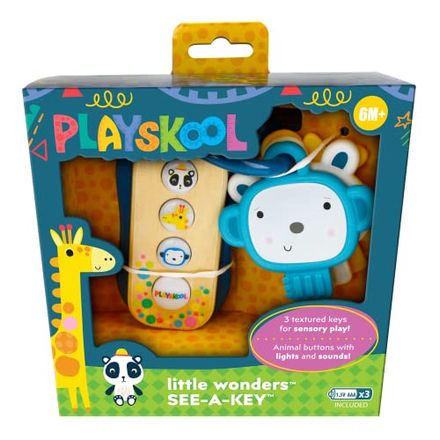
How the battery lid opens. A coin slot or a cross-head screw is right. A lid that pops off with a fingernail will come off.
What usually comes next
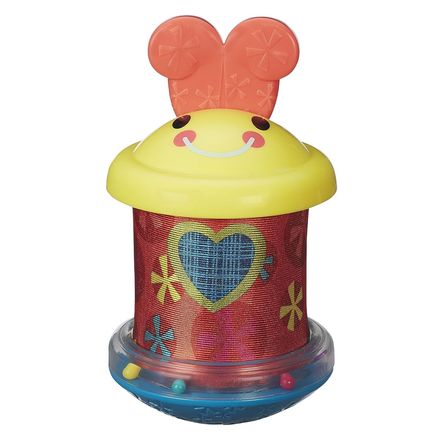
A popper buys the most months of the three, because it works from a palm slap at nine months and still works as a chase game at two. Gear stacks come second — the gears go on in any order, so there is no wrong answer and no frustration.
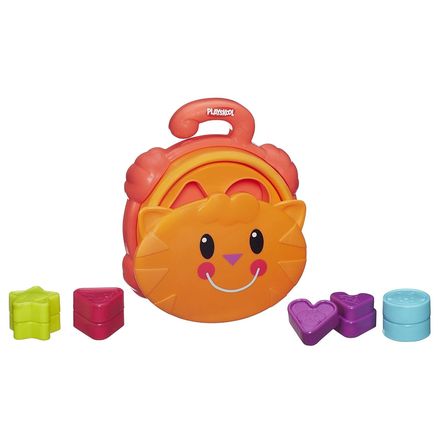
Shape sorters are the slow burner. For the first few months the lid comes off and the shapes go in and out of the bucket, which counts. Matching the hole to the shape starts somewhere around eighteen months.
What this means for the Playskool toys on these mats
The floor stays the way it is described above: Playskool boxes on eight mats, one mat per kind of afternoon. Parents reading this with a toddler on one arm can skip to a mat, and small explorers will sort the blocks out themselves.
The blocks bin is its home address. Parents who want one Playskool box to cover a whole stage usually land on something like this, and the Playskool build means it is still there for the next child.
Children play with this standing, sitting and lying across it, so the shell is built for all three. Little explorers test everything by dropping it, and the fun survives the test.